
Why category signals in Japan do not validate market assumptions, positioning, or investment case.
The CEO joined a few minutes late from Europe. The rest of his team and I had already exchanged the usual introductions. When he got online, he cut straight to it. “We are exporting to many countries,” he said, then started listing European countries one by one with the quiet satisfaction of someone used to success. Then he continued: “Next year is Japan.” “We have already applied to FoodEx.” The category, he argued, was growing there. Then he pointed out the broader assumption underneath it all: “Japanese consumers like Mediterranean flavors, right?”
The exchange is condensed, but the logic is familiar. I have heard some version of it many times before.
And that is exactly why it matters. Conversations like this are not just about export ambition. They often sit right upstream of capital allocation, revenue expectations, and market entry investment decisions. By the time a company gets to this stage, the commercial thesis is usually already taking shape. In some cases, so is the internal investment case. The product may be strong, the category data may be real, and the opportunity may well exist. But if the assumed position of the product in Japan is wrong, the forecast built on top of it is likely wrong too.
On the surface, this case was convincing: the company was serious, the product was credible, and the underlying market signals were real. However, even as the conversation moved forward, something felt off: the problem was not the product. The problem was the position the product was assumed to occupy once it arrived, and the commercial and investment expectations built on that assumption.
In its home market, this company is not niche, experimental, or marginal. It is established, and it operates from a position of familiarity and earned trust. Its products fit naturally into existing consumption patterns and commercial channels. And that position took years to build, and it is real.
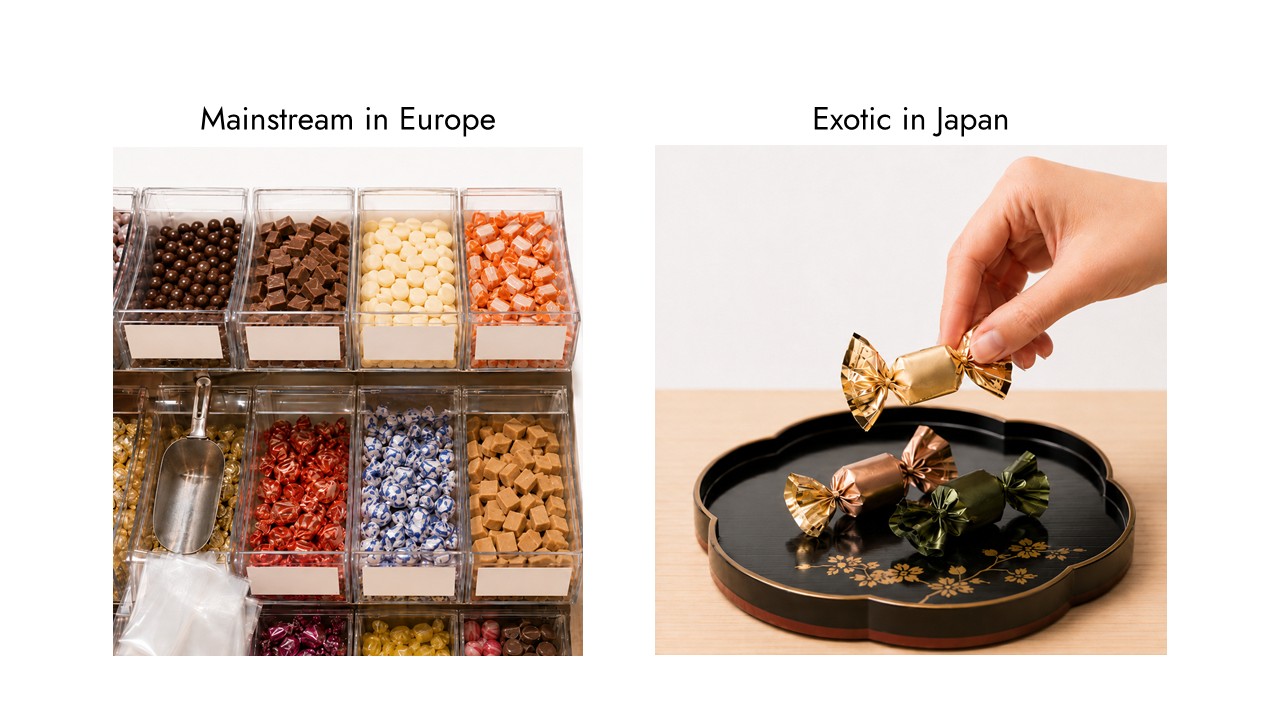
In Japan, however, the same product enters under completely different conditions. While it may still attract curiosity, curiosity is definitely not routine, and novelty is definitely not staple demand either. A product that is commercially normal in one market can arrive in another as something interesting but occasional. It is picked up once, tried with interest, but then left behind as consumers return to what already fits into their weekly habits. That is not a verdict on quality. That is a structural fact of market context, and one that tends to be obscured by reassuring charts, category expansion, and growth trends.
This is where many market entry plans begin to drift away from reality. The data itself is often correct. In this case, the category was growing in Japan. The flavor territory also had visible traction. Those signals were real, and easy enough to verify. But they did not answer the question that mattered most: once the product reached the shelf, what role would it actually play in the consumer’s life?
Would it become part of repeated weekly consumption, or remain occasional? Would it compete in practice with other imported products, or with domestic defaults that consumers already buy without thinking? Market size and growth trends do not tell you that. Yet those are the questions that determine whether the business case holds.
Mediterranean food is a good example of how easily this gets misunderstood. In Europe, many Mediterranean flavors belong to everyday eating. In Japan, by contrast, only some formats have become part of routine consumption. Much of the broader flavor world still sits closer to occasional use, restaurant consumption, or trial-driven variety than to weekly household habit.
In the example case, a Mediterranean-flavored specialty snack may win the first purchase through distinctiveness. But on the next shopping trip, it is no longer competing with an abstract “Mediterranean” opportunity. It is competing with familiar domestic options that carry less uncertainty, require no explanation, and fit seamlessly into existing habits. The first purchase may be easy. The second and third are where the real market begins. This is the repurchase problem that broad category data tends to hide.
The same mismatch appears elsewhere too. Organic is one example. In much of Europe, organic has developed into its own ecosystem, with dedicated retail logic and a consumer base that often shops for it intentionally. In Japan, the market exists, but usually in a less separated way. Organic products are often absorbed into broader categories, placed beside conventional alternatives rather than inside a distinct consumer world. A brand built around speaking to a clearly self-aware organic tribe can arrive in Japan and discover that the shelf does not work the same way, and neither does the shopper. Those differences can produce very different outcomes even when the product and effort look similar on paper.
Vegan positioning reveals a similar gap at the level of symbolism and identity. In Europe and North America, plant-based products often carry ideological meaning. In Japan, plant-based eating sits inside a much older cultural history. Tofu is not a statement. It is simply food. So a brand can arrive with strong vegan messaging and find that the market is not rejecting the proposition. It is simply not responding to the symbolism in the same way.
There is another complication here as well. Some value propositions travel better in buyer conversations than in consumer behavior. Claims such as traceability, production control, or sustainability may help de-risk a product for an importer or retail buyer without creating much repeat demand at shelf level. A brand can receive encouraging B2B reactions and still fail to generate the consumer pull needed to justify its original commercial expectations.
None of this means there is no market. Usually there is. The issue is not that the numbers are false, but that bold expectations around revenue, speed, and scale are often built on the wrong assumption about the product’s likely role in Japan.
Once that role is assessed more honestly, the opportunity often changes. The realistic addressable segment becomes smaller, repurchase less certain, and the required investment heavier and more specific than initially assumed.
That does not mean a brand must accept an exotic or occasional position forever. Some companies do move from curiosity to habit. But that is a different investment case. It requires more time, more capital, and a clearer willingness to shape demand rather than simply test for it.
The mistake is not in entering at an exotic starting point. The mistake is in planning as if that starting point will behave like home-market familiarity without the investment required to change it.
That is why European brands that are mainstream at home so often miscalculate Japan. They carry over the economics of familiarity into a market where they will initially be treated as exotic. They project staple-like volumes onto occasion-like behavior. They assume that because the category is growing, their own brand will naturally capture part of that growth. But mainstream logic does not travel automatically.
This matters not only for operators, but also for investors and decision-makers allocating capital. Due diligence may confirm category size, growth trends, the existence of consumer interest, or even the apparent strength of potential local partners. What it often fails to test is the product’s likely place within actual weekly consumption, and the level of investment required to shift that place over time.
Two questions are worth bringing into that discussion early.
First, what role will this product realistically occupy in the Japanese consumer’s week: routine, occasional, or trial-only?
Second, what level of time, capital, and local market adaptation would be required to move it from curiosity to repeat purchase?
Those questions may matter more than the category report.

About the author:
Marton Lendvai
CEO & Founder of TOO International
Marton Lendvai is the CEO and founder of TOO International, a Tokyo-based Japan market advisory and business development firm. He helps European food and beverage companies assess whether Japan is commercially realistic, how the market could work, and what should be clarified before investing further in partner search or execution.
His perspective is grounded in more than 20 years of business experience in Japan and over a decade of hands-on brand-side market development with Japanese distributors, buyers, and local partners.
Full bio (see the "Meet Marton" section) Connect on LinkedIn

Five internal risk filters that determine whether Western F&B products move forward in Japan.

5-year import data (2020–2024) reveal Japan’s fast-growing drink categories and 2026 outlook.

Business development tactics to help import F&B brands in Japan prepare for and grow beyond entry.